Creative Productions, Arrangements and Operations • Art, Technology and Amusements. Software Engineer and certified FileMaker Pro developer and full-stack web developer by day, https//www.kupietz.com
Firefox as of v 148 (actually a bit earlier than that, but that's what I'm on right now) frequently decides not to load pages anymore. You enter a URL or click on a link and get the status message "Waiting for [URL]..." and you can wait as long as you care to.
When this begins, your only choice is to restart Firefox.
Here is a list of "solutions" to the problem from around the web, which I have tried and found do not fix the problem: • Turning off DNS-over-HTTPS in Firefox Settings • Flushing MacOS's DNS cache. • Going to about:networking and clearing Firefox's DNS cache • Going into about:config and changing network.dns.disableIPv6 from false to true • Opening in "troubleshooting mode" or disabling all extensions • Turning VPN off • Turning VPN on
Long story short, I got a message from a user that audio playlists were working in Firefox but not Chrome. The Chrome console had an error that "jQuery" wasn't defined, but typing jQuery into console did show a function definition. Turns out, in Lightspeed Cache's JS Delayed Includes, I had entered the word jquery by itself on a line, with a note to myself that something was causing a browser flash if I didn't do that. But removing this made the playlist shortcodes work on Chrome again. Ergo: don't defer jQuery.
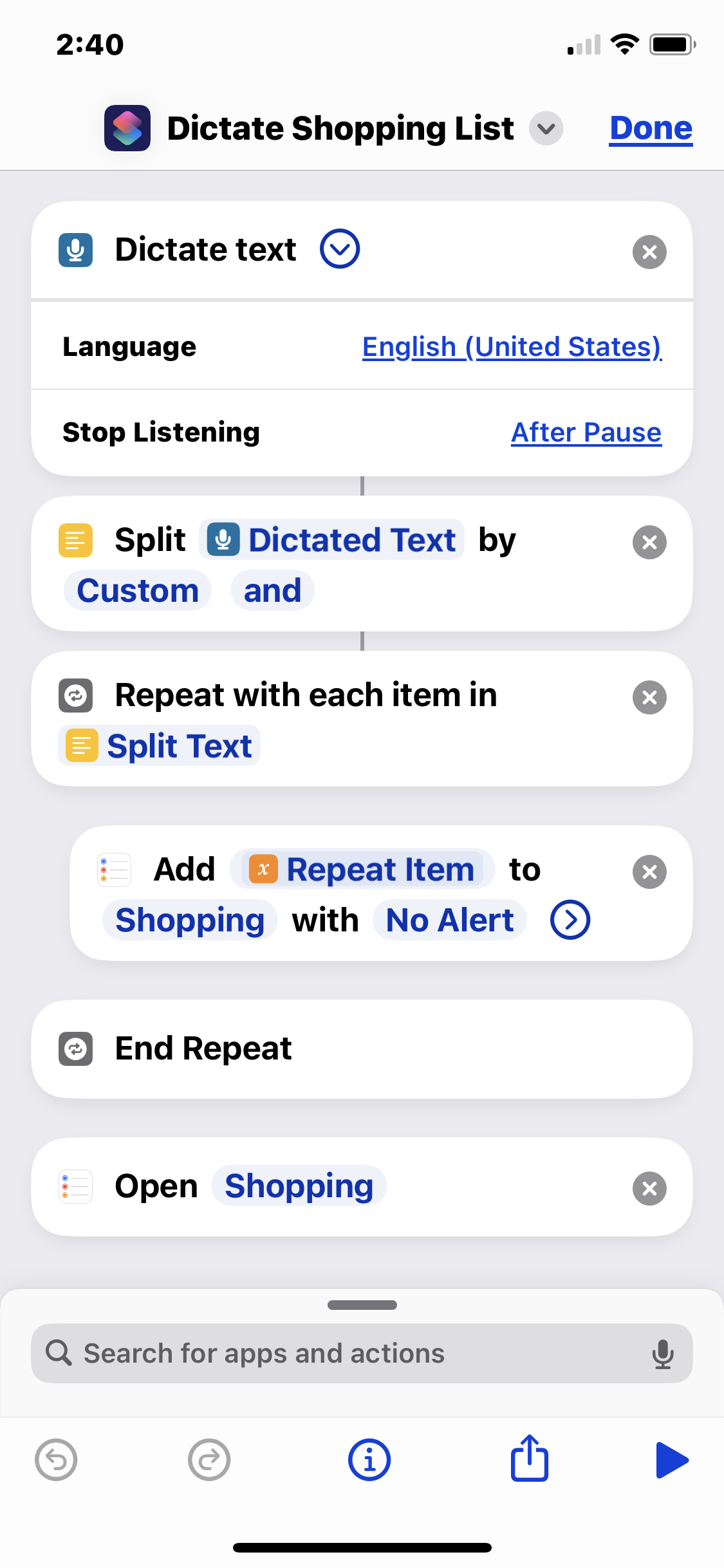
I uses this shortcut to dictate my shopping list into the iOS Reminders "Shopping" list. It breaks spoken lists on the word "and" to create separate shopping list items.
So I might run the shortcut, say the phrase "pickles and hot dogs and mustard", and it will add "pickles", "hot dogs", and "mustard" as separate checkbox items to the Shopping list in Reminders. It's handy for rattling off my shopping list as I'm staring into my fridge.
Obviously you need a list called "Shopping" set up in your Reminders app.
This shortcut executes the following steps:
Dictate text - listens for spoken input. Make sure set to '''stop listening after pause'''.
Split Dictated Text by Customand - splits the text into a list with "and" as the delimiter
Repeat with each item in Split Text - begins the loop that adds…
SSHing into a local MacOS machine at address "macbook.local", I suddenly got this:
[code]@@@@@@@@@@@@@@@@@@@@@@@@@@@@@@@@@@@@@@@@@@@@@@@@@@@@@@@@@@@ @ WARNING: REMOTE HOST IDENTIFICATION HAS CHANGED! @ @@@@@@@@@@@@@@@@@@@@@@@@@@@@@@@@@@@@@@@@@@@@@@@@@@@@@@@@@@@ IT IS POSSIBLE THAT SOMEONE IS DOING SOMETHING NASTY! Someone could be eavesdropping on you right now (man-in-the-middle attack)! It is also possible that a host key has just been changed. The fingerprint for the ED25519 key sent by the remote host is SHA256:oKCEu3pDdq7xBhSPZwOzR2q0eWTvfphtvn3D4Bjz8v4. Please contact your system administrator. Add correct host key in /Users/username/.ssh/known_hosts to get rid of this message. Offending ECDSA key in /Users/username/.ssh/known_hosts:147 Host key for macbook.local has changed and you have requested strict checking. Host key verification failed.[/code]
The solution was to run ssh-keygen -R macbook.local then try the ssh again. Then it asked me whether or not to accept the key, instead of rejecting it:
[code]$ ssh username@macbook.local The authenticity of host 'macbook.local (fe80::1890:fd32:c304:69cd%en0)' can't be established. ED25519 key fingerprint is SHA256:oKCEu3pDdq7xBhSPZwOzR2q0eWTvfphtvn3D4Bjz8v4.…
If CSS animations cause a layout shift even if they're on compositable ettributes, look for clip paths, overflow:hidden, or css filters on them or their ancestors.
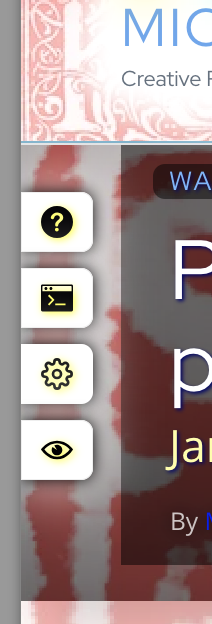
So, I had a crazy problem. You'll notice that there's various draggable elements on this site... such as the "Kupietools" plugin tabs seen at left, the occasional "the site is being worked on right now" notices that pop up, etc. You can drag them around with your mouse.


This is done with a plugin (also available as a standalone javascript module, a few versions behind the plugin as I write this) that retrofits code onto various HTML elements by giving the plugin the classnames it needs to make interactive.
I was doing some optimization on the site loading to speed things up, such as getting WordPress to load a lot of CSS file late so as not to interfere with initial page load stats. (This is a whole art, beyond the scope of this article.) Suddenly…
I got the error "The number of lookups on your SPF record exceed the allowed limit of 10. This will result in emails failing SPF authentication" in my Cloudflare DNS dashboard.
My spx record for, say, kupietz.com was "v=spf1 include:_spf.myEmailHost.com include:kupietz.com ~all"
Turns out, the problem is, every include can get parsed to be multiple servers. the include:kupietz.com apparently causes a recursive loop, creating more than 10 lookups. I updated it to "v=spf1 ip4:[my server's external IP address] include:_spf.google.com ~all", removing the recursive lookup, and adding my server's IP so it can send me administrative notices.
Also today my ISP changed my IP address unexpectedly... all DNS updated.
To make a complete local backup of a remote WordPress install over SSH, you need to perform two distinct steps:
Download the files (using rsync).
Export and download the database (using mysqldump piped through ssh).
Here is the step-by-step guide.
Prerequisites
SSH Access: You need the username, host (IP or domain), and password (or SSH key) for the remote server.
WordPress Path: You need to know where WordPress is installed (e.g., /var/www/html or /home/user/public_html).
Database Credentials: You will need the database name, user, and password. (I will show you how to find these below).
Step 1: Find Database Credentials (Optional)
If you don't know your database login details, run this command to read them from your remote wp-config.php file: ssh user@remote-server.com "cat /path/to/wordpress/wp-config.php" | grep 'DB_'
Note the DB_NAME, DB_USER, and DB_PASSWORD for Step 2.
N8n by default binds to localhost, and even binding it to listen on all interfaces, it still by default listens only for IPv6. You also may want to tell it to not use the Secure Cookie if you don't want to set up an SSL certificate or sign up for their cloud service. Make sure you only have it reachable on the local network if you do this, you don't want to open your instance to the entire world.
Note: Facebook changes their css often. This may not work for long.
Also, uBlock Origin is not always the fastest plugin, you may see the Instagram posts briefly on your screen before it removes them.
How to Block Instagram Shares from Facebook Using uBlock Origin: A Complete Guide
Social media platforms have become increasingly interconnected, with content from one platform frequently appearing on another. For Facebook users, this often means encountering Instagram shares in their news feed—sometimes from accounts they follow on both platforms, creating redundant content, and sometimes from accounts they don't follow on Instagram at all, courtesy of Facebook's algorithmic recommendations.
If you're looking to curate a cleaner Facebook experience by filtering out these Instagram cross-posts, browser extensions like uBlock Origin offer a powerful solution through custom…
I screenshare into a Mac for playing video on my TV, and had an intermittent problem where Firefox would not play video while screen sharing was connected, but then locked the screen as soon as I disconnected.
It turns out that if the screen is locked when you log in via screensharing, MacOS defaults to locking it again when you disconnected, and, being MacOS, the ability to turn this off has been removed from the UI.
Enter this in terminal to turn it off: sudo defaults write /Library/Preferences/com.apple.RemoteManagement RestoreMachineState -bool NO
I had a truly maddening problem where my /embed/ functionality was sometimes returning full pages to CURL commands and online services like redirect-checker.org, etc.
It turned out, it was Yoast's URL parameter stripping. I had failed to update Yoast's settings with some new parameters I was using, and what Yyoast never tells you is that when you're logged in, it lets everything work fine, and only strips parameters for non-logged in users. It just lets you proceed on your way thinking everything is working fine until you can't figure out why curl -I https://mysite.com/blah?param1¶m2 is getting a 301 redirect while https://mysite.com/blah?param1¶m2 is loading fine in your browser. This is especially fun on sites like mine where things like /embed/ and ?embed get written back and forth to each other internally.
I lost several hours to this.
Yoast's docs say there's a way of registering parameters but,…
The problem was, I needed to make some changes to how that code functioned, and I couldn't find where I had added the script that did that.
Long story short: I temporarily added this script to the head of the page, and then reloaded it with an #anchor added to the URL, in this case [code]https://michaelkupietz.com/literally-hundreds-capsule-reviews/#puzzlehead[/code]:
[code] // Override the open property setter to catch when…
Here's the SQL query to get all post revisions, which I do prior to cleaning them out of the database, which seems to make it much faster:
SELECT p.* FROM [posts table name] p WHERE (p.post_type = 'post' OR p.post_type = 'page') -- Include posts/pages AND (p.post_date BETWEEN '2020-01-01' AND '2029-07-01') -- Adjust date range OR (p.post_type = 'revision' AND p.post_parent IN ( SELECT ID FROM [posts table name] WHERE post_date BETWEEN '2024-01-01' AND '2024-07-01' ));
To get just a count of revisions, change SELECT p.* to SELECT count(*).
I removed a bunch of wildcard paths from rsnapshot.conf's exclude, and suddenly tonight my backup ran in a few minutes instead of taking over a day like it usually does.
Interesting, I've been looking off and on for at least the better part of a year for ways to lighten the load of rsnapshot's under-the-hood rsync backup commands, which reliably took up about half my CPU power almost continuously, and never found this tip before. You can see, plenty of wildcard paths removed, plus a few other things.
Here's a diff, rsnapshot.conf before changes (<) vs after (>): < verbose 1 --- > verbose 4 120c120 < loglevel 2 --- > loglevel 4 143a144,146 > rsync_short_args -Wa > #-W is transfer whole files without prescan, recommended for performance by https://serverfault.com/questions/639458/rsync-taking-100-of-cpu-and-hours-to-complete > #NOTE: if you set the above short…
I had an interesting problem where I set an image's CSS rules to display:fixed and it still scrolled with the page. Here's what I discovered:
In CSS, display:fixed means fixed with regard to the nearest ancestor stacking context, not necessarily to the page coordinates. You can reset the stacking context by adding a transform, will-change, or other attributes (list provided below) to an element. If an ancestor element resets the stacking context, any descendant of it with display:fixed will stay fixed with regard to it, but if it scrolls with the page, will scroll too.
Ditto for the CSS attribute z-index. A higher z-index is only in front of objects in its stacking context. A new stacking context, lower down on the page, can contain elements with a lower z-index but that nonetheless appear in front of it visually, because they're not in the same stacking context.
- added var_dump(opcache_get_status()) to php status page to be able to monitor opcache usage
- changed warning logs from E_ALL & ~E_DEPRECATED & ~E_STRICT to ---- noticed contained a LOT of processes being stopped for tracing turned off request_slowlog_timeout by setting to 0s in had been 4s --- I had turned on lightspeed at 1:45 am est , aug 26. Seems like more problems since then.
None of the above seem to help, still getting freezes maybe every 30 minutes. Next…
I discovered rsnapshot hadn't run in a few days. Checking /etc/rsnapshot.log, I found every recent day had this:
rsync: --delete does not work without --recursive (-r) or --dirs (-d). rsync error: syntax or usage error (code 1) at main.c(1795) [client=3.2.7]
A few days ago I had added the line rsync_short_args -W to /etc/rsnapshot.conf in an effort to get rsync to run without putting such a load on my system. Removing this and running rsnapshot -v hourly from the command line shows that without it, the first line of the rsync command was /usr/bin/rsync -ax --delete --numeric-ids --relative --delete-excluded \, but with it, the first line was /usr/bin/rsync -Wx --delete --numeric-ids --relative --delete-excluded \.
Changing the line rsync_short_args -W to rsync_short_args -Wa, with an a flag explicitly included, solved the problem. Apparently specifying custom short flags overrides at least one of the default flags.
There are intentionally vague broad steps, here just as a reminder to myself; best to look specific instructions for each of these steps up at restore time for the particular system you're restoring to.
A.) Backups should include all user data. Depending on who you ask, that's either: 1.) The entire filesystem except /dev/*, /proc/*, /sys/*, /tmp/*, /run/*, /mnt/*, /media/*, /lost+found (which can be pulled from a complete filesystem backup with rsync -avhP --exclude={"/dev/*","/proc/*","/sys/*","/tmp/*","/run/*","/mnt/*","/media/*","/lost+found"} /mnt/olddrive/ /mnt/netdrive/) 2.)/home, /etc (except /etc/passwd and /etc/groups, these have useful information to back up but may conflict if written to a new install), /usr/local, /opt, /root, /var (exluding /var/tmp, /var/run/, /var/lock, or /var/spool except you DO want /var/spool/cron/crontabs/)
B.) After copying all the above to the new or restored disk, you need to update /etc/fstab with the new disk UUIDs.
Per numerous references around the web, to delete /path/to/directory-to-delete/:
cd /path/to/ mkdir empty_dir rsync -a --delete empty_dir/ directory-to-delete/ rm -r empty_dir rm -r directory-to-delete
Disclaimer: this is for my own reference, not recommended for your use. Use it at your own risk. If I am wrong—and I may be—these commands can do tremendous damage to your system.
Here’s a guide to all currently available CSS units, with explanations and common use notes. This includes all CSS units listed in MDN Web Docs as of 2025aug15.
My VWWare VM lost internet connectivity after a reboot. Even the host machine could not access any service on it. Http/https got 523 errors.
I powered down the VM, changed the networking to NAT, powered it back up, shut it down again, changed the networking back to Autodetect, booted it again, and everything seemed fine.
I've had sporadic problems with clearing the WP cache causing the server to return 520 errors for a few minutes. Usually other sites on the same server are fine, it's specific to this vhost. Logging in via SSH, checking with htop, rsync is usually hogging most of the cpu. Restarting the fpm and then restarting Apache restores the website.
According to https://www.claudiokuenzler.com/blog/361/rsnapshot-backup-reduce-high-load-with-ionice, the big bottleneck with rsync, which rsnaphot runs on, is i/o, not cpu, and rsync can actually tie up i/o such that a web server won't respond to http requests. This can be solved by making the rsnapshot command in crontab ionice -c 3 [rsnapshot command] instead of just the rsnapshot command, which tells rsync not to wait until the disk is idle before trying to access it. So I did. In fact, I made it nice -n 19 ionice -c 3 [rsnapshot command] although…
Use code you find here at your own risk! I am not responsible if you damage your data or system by following any instructions you find here.
Navigate to your plugin's root directory:
Bash
cd /home/kupietzc/public_html/kartscode/wp-content/plugins/ktwp-draggable-elements
Fetch the latest changes from GitHub: Bash
git fetch origin
Perform a hard reset to match GitHub's main branch (assuming main is your branch):
Bash git reset --hard origin/main
WARNING: This command is destructive. It will discard all local changes to tracked files and make your local repository exactly match your GitHub repository. Ensure you have a backup of any local modifications you wish to preserve that are NOT on GitHub before running this.
Clean up any untracked files or directories (remnants from manual copying): …
Posted inImage GalleryPosted in genresGeek StuffWebsite Images
.cellimglink > .mk-cell-img {border-radius:0 !important;}Buttons Kupietz Arts+Code buttons "Built During An Indieweb Meetup" buttons I strongly suggest, if you use…
For confused first-time visitors and other people still acclimating, here is a description of these little tabs to the left, as well as some other features of the site.
Open "Expert Mode" CLI Navigation - this give you the option to switch your browser's display to an old-fashioned terminal mode where you may browse this site, view pages and images by typing text commands. Just like how we used to browse the web back in 1978!
Open Visual Settings - This gives you controls to customize the visual display of this website to your liking: turn up or down the brightness, contrast, color temperature, hue, saturation, dark mode, and earthquake. Settings are saved per browser tab, so they will be remembered for your whole visit.
Open My Eyes - Have you ever been engrossed in your work, when you suddenly realize someone is staring at your screen, watching everything you do over your shoulder? If not, this simulates the experience.
Open Help - This help popup, silly! You just clicked it! Do you not remember?
New - Draggable elements! Several elements on this website, including these tabs, this popup message, and the "Hire Mike" badge in the lower right, can be dragged around with your mouse, to avoid them blocking content. Positions are remembered per tab, so as you navigate around the site, they will stay in the same place for your whole visit.
Enjoy!
CLI Website Navigation
Are you sure you want to switch to viewing this website in the "expert mode" command-line interface?
This will switch to a terminal emulator, load this page, and allow you to browse this website and view its contents by typing text commands.
Plus there might be, y'know, some fun stuff hidden in there. Just for geeks.